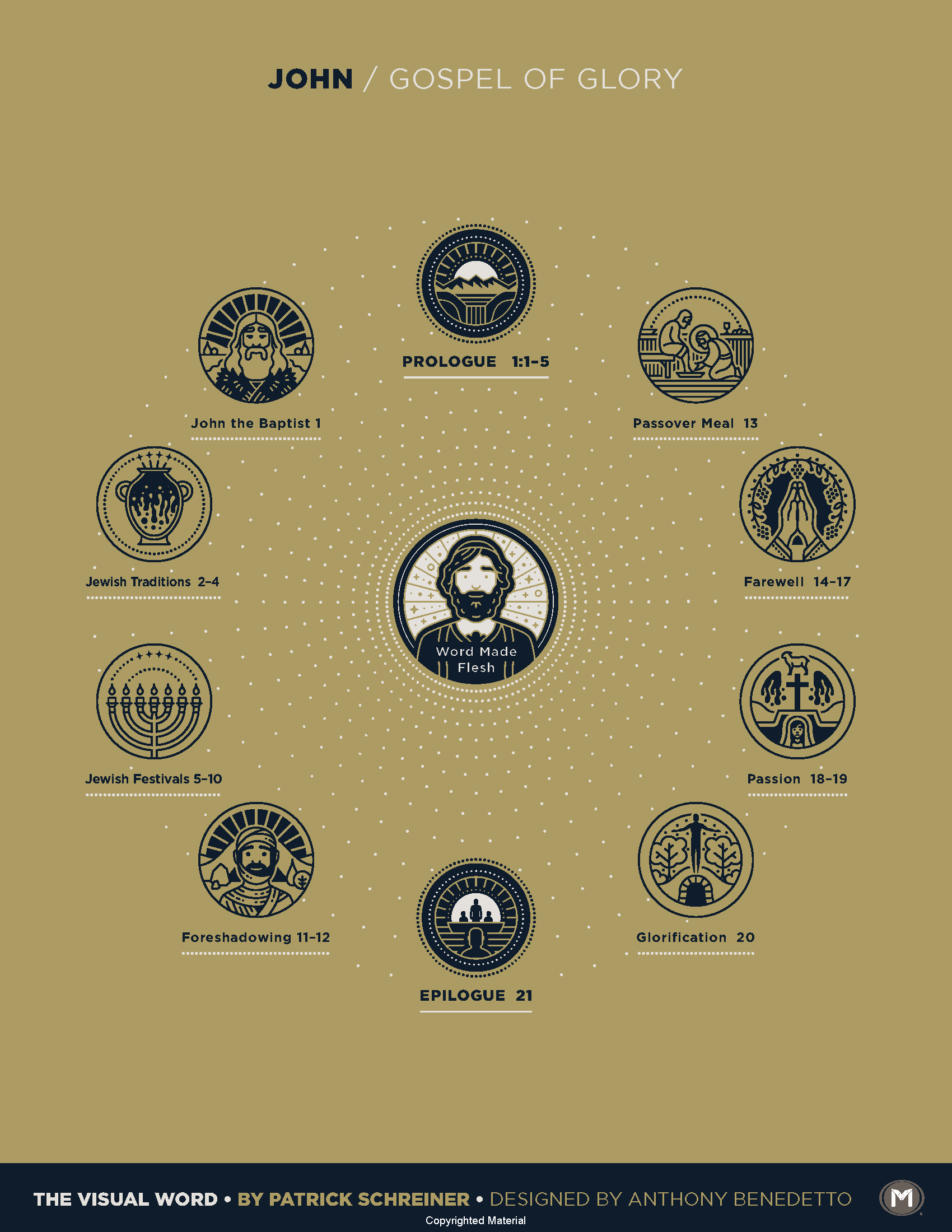
The Gospel of John
Like the other three gospels, John also is symbolized by one of the four creatures mentioned in Ezekiel. In his case, an eagle. A majestic eagle soars through the sky, representing the divine presence of Jesus descending from above. Moreover, as an eagle soars, it gains a unique perspective of the world, much like John provides profound insights and theology through his gospel as well as divine revelations.
Theme to Watch for
The gospel of John emphasizes that salvation is available to all who pledge their lifelong loyalty to Jesus. As you read this gospel, look for signs that John wrote that would lead the reader to believe that “Jesus is the Christ, the Son of God, and that believing you may have life in His name (John 20:31, ESV).”
About the Author
Through context and comparing John to the other gospels, we can determine that John refers to himself as the “disciple whom Jesus loved.” This is not a humble brag but rather an acknowledgment that John finds his identity in the love Jesus has for him and that alone. In the final section of his gospel, he affirms his authorship.
After Jesus was resurrected, He met with His disciples near the Sea of Galilee. Jesus was talking with Peter about John. He says:
“Peter turned and saw that the disciple whom Jesus loved was following them. (This was the one who had leaned back against Jesus at the supper and had said, “Lord, who is going to betray you?”) When Peter saw him, he asked, “Lord, what about him?”
Jesus answered, “If I want him to remain alive until I return, what is that to you? You must follow me.” Because of this, the rumor spread among the believers that this disciple would not die. But Jesus did not say that he would not die; he only said, “If I want him to remain alive until I return, what is that to you?” This is the disciple who testifies to these things and who wrote them down. We know that his testimony is true. Jesus did many other things as well. If every one of them were written down, I suppose that even the whole world would not have room for the books that would be written (John 21:20-25, ESV).”
John was one of the twelve disciples (Matthew 4:18-22), and he had a perspective that was unique since he was one of the three disciples who were closest to Jesus.
He was present during the transfiguration, as well as many of the miracles like the resurrection of Jairus’ daughter (Mark 4:37), and he was one of the three disciples Jesus brought with Him into the garden of Gethsemane the night He was arrested.
John is also the only disciple of the twelve who is documented as being present at the John is also the only disciple of the twelve who is documented as being present at the cross when Jesus was being crucified.
“Near the cross of Jesus stood his mother, his mother’s sister, Mary the wife of Clopas, and Mary Magdalene. When Jesus saw his mother there, and the disciple whom he loved standing nearby, he said to her, “Woman, here is your son,” and to the disciple, “Here is your mother.” From that time on, this disciple took her into his home (John 19:25-27, NIV).”
John was the sibling of “James the Great.” These two were fishermen notably regarded as the sons of Zebedee and were also dubbed the sons of thunder. According to Polycrates, Bishop of Ephesus, and Irenaeus, two early church fathers, John spent his final years in Ephesus, and it is widely believed that he wrote his gospel there. According to Tertullian, a theologian from the 2nd century in North Africa, there is a record of John being subjected to boiling oil and miraculously escaping unharmed. Jerome, an early church father from the fourth century, believed that John lived to be in his late 90s. He mentioned that John’s death occurred in “the sixty-eighth year after our Lord’s passion (death).”
When was it written?
It is highly probable that John is the latest gospel account written. Most scholars agree that the dating for John’s gospel is between 55 AD and 95 AD. The debate surrounding the dating of this gospel all depend on the fall of the temple which took place in 70 AD.
Those who believe in earlier dating’s argue that John would have mentioned the traumatic destruction of the temple seeing as it was of immense significance to the Jewish people. There are some scholars who argue that the book subtly alludes to the destruction of the temple and places the gospels emphasis on theological themes that promote this idea. Regardless, we can safely place the dating of this book within the date range mentioned above.
About the Audience
We can deduce John’s audience from 20:31:
There are also many other signs (attesting miracles) that Jesus performed in the presence of the disciples, which are not written in this book; but these have been written so that you may believe [with a deep, abiding trust] that Jesus is the Christ (the Messiah, the Anointed), the Son of God; and that by believing [and trusting in and relying on Him] you may have life in His name (AMP).
Based on the statement that this gospel was written “so that you might believe,” it can be inferred that the author’s intended audience was probably not Christians who have already pledged their eternal loyalty to Jesus. Scholars suggest that John is writing to a Jewish population. To take this a step further, the verses say that you might believe that Jesus is the Christ.
The fundamental question the Fourth Gospel addresses is not ‘Who is Jesus?’ but ‘Who is the Messiah? Who is the Christ? Who is the Son of God?’ In their context, these are questions of identity, not of kind: i.e. the question ‘Who is the Christ?’ should not here be taken to mean ‘What kind of “Christ” are you talking about?’ but ‘So you claim that you know who the Christ is. Prove it, then: Who is he?’ These matters are discussed in the commentary on 20:31, and the technical warrants are provided in Carson (‘Purpose’). For now, it is sufficient to observe that Christians would not ask that kind of question, because they already knew the answer. The most likely people to ask that sort of question would be Jews and Jewish proselytes who know what ‘the Christ’ means, have some sort of messianic expectation, and are perhaps in dialogue with Christians and want to know more.
Moreover, upon examining the gospel of John more closely, it becomes evident who the author had in mind as the recipients of his message. Just to give you an idea, Jesus’ Messianic nature is mentioned multiple times throughout the text (1:36, 41, 49, 3:18; 4:25, 29; 5:25; 7:26, 27, 31, 41, 42, 27; 12:34; 19:7; 20:3, 31). Also, we have the “I Am” statements, which were a significant declaration in Jewish culture, indicating that He was claiming that He was God. Next, take a look at Jesus as the fulfillment of the Jewish festivals. Jesus also claims to be the temple (2:14-22), a concept of great importance in the Jewish world. Finally, He surpasses all the standards of being our sacrifice, something that only those familiar with the Old Testament would have recognized. As an illustration, consider Leviticus 22:22 along with John 19:33.
It is widely recognized that John’s gospel has a strong evangelistic nature. While it may have been originally intended for the Jewish audience and Jewish converts, this book holds relevance for people of all backgrounds. He wants to see all come to Christ.
What Kind of Relationship Did Mark Have with His Audience?
John was a Jew who converted because he was called by Jesus. He clearly has a deep affection and optimism for the Jewish people, desiring for them to experience the same sense of hope that he has found in the Messiah’s arrival. In addition, He is deeply committed to testifying about Jesus and helping others find their way to Christ.
Historical & Cultural Factors to Keep in Mind
Two temples were built: Solomon’s Temple and Herod’s Temple. The first was destroyed when the Jews were conquered by Babylon, and the second was destroyed by Rome in 70 AD. As modern Christians, it is rather difficult to find a parallel to the complex connection between the temple and the Jewish people. The best example I can give, although it pales in comparison, would be to picture Washington D.C. being destroyed.
Why was the gospel of Luke written?
John gave specific reasoning for why his gospel account was written. “Jesus performed many other signs in the presence of his disciples that are not written in this book. But these are written so that you may believe that Jesus is the Messiah, the Son of God and that by believing you may have life in his name (John 20:30-31, CSB).” Over 90% of John’s gospel is unique in comparison to the synoptic gospels. For comparison, 90% of the stories in Mark’s gospel are also in Matthew and Luke’s.