The Gospel of Luke
The gospel of Luke is symbolized by an ox. This animal is regularly offered for sacrifice, which is the central theme in the Gospel of Luke. The Gospel emphasizes the sacrificial nature of Christ’s, so it is not a surprise that it begins with Zechariah carrying out his priestly duties.
Theme to Watch for
Jesus is the living sacrifice for both Jews and Gentiles. He died so that we might live. Compared to the other gospels, Luke’s gospel contains a higher number of references to the temple. The gospel starts in the temple and also ends there. Luke’s intention in the text is to emphasize that the gospel message originated in Israel but is meant for everyone, including both Gentiles and Jews, as they are the ones who form the Church.
About the Author
The Gospel of Luke does not mention the author of the gospel itself or its sequel, Acts. However, doubts about its authorship did not arise until the late nineteenth century. The early church strongly affirmed that Luke wrote the gospel. For this reason, we believe that Luke wrote this gospel.
Due to the proper Greek used, we know that the writer was an educated man. Like Mark, Luke, a beloved physician (Colossians 4:14), was also a companion of Paul, frequently traveling with him on his missionary journeys (2 Timothy 4:11; Philemon 1:24). He uses the pronoun “we” throughout Acts, which confirms his presence on these missionary journeys.
“Other traditions inform us that he lived until he was 84, but he never married and so died childless. He was also said to be an artist. Whether he was a painter of first rank remains a speculative question, but that he was a word-artist is indisputable.” [1]
When was it written?
Many scholars agree that the Gospel of Luke was likely written in the early 60s AD, shortly after the events described in Luke 28. There is speculation that Mark and Luke may have had a strong connection, as they both traveled with Paul and are mentioned together in some of Paul’s letters. Moreover, given the striking similarities in 350 verses that Luke probably based on Mark’s gospel, it is reasonable to assume that Luke composed his gospel after Mark. Given that Mark’s gospel is dated between the mid-to late-50s, it seems appropriate to assume that Luke’s gospel would be dated in the early 60s.
About the Audience
The book of Luke, unlike the other three gospels, very clearly lays out who the intended audience is. In Luke 1:1–4, it says:
“Many have undertaken to draw up an account of the things that have been fulfilled among us, just as they were handed down to us by those who, from the first, were eyewitnesses and servants of the word. With this in mind, since I myself have carefully investigated everything from the beginning, I too decided to write an orderly account for you, most excellent Theophilus, so that you may know the certainty of the things you have been taught (NIV).”
So then, the question now becomes, “Who is Theophilus?”
Some scholars have suggested that Luke’s gospel may have been written with a specific group of people in mind, given the meaning of the name Theophilus, which translates to “city of God.” Some suggest this could be a symbolic name rather than a proper name. Origen (ca. ad 185-254) was the first to suggest this possibility. It was common practice for Greek authors to dedicate their works, and ‘Theophilus’ is a well-known Greek name, documented from as early as the third century bc [SIC].
Other scholars believe that Theophilus is a man of military rank, as suggested by the mention of “most excellent” in Luke 1:3. There are discussions taking place regarding Theophilus’ religious beliefs, with some arguing that he is already a Christian while others believe he is still in the process of deciding whether to embrace Christianity.
“[It appears Theophilus] doubts whether in fact he really belongs in this racially mixed and heavily persecuted community [Christianity].”
It was a common practice for affluent individuals to hire someone to pen books and various other pieces, with the understanding that their name would be linked to the work. It’s highly probable that this is the situation with Luke and Theophilus.
It is worth noting that while this gospel was specifically written for Theophilus, it is clear that Luke intended it to be read by a broader audience, particularly Gentiles. This gospel was written as an open invitation for any gentile who could feel like an outsider in this movement that had Jewish roots. Luke wanted to offer reassurance to them.
What Kind of Relationship Did Mark Have with His Audience?
It appears that Theophilus was familiar with Jesus and the events that surround this Messiah. (Luke 1:4) Luke writes to Theophilus with the expectation he understands “what” happened and is determined to explain “why” it happened and what this means. Some traditions place Luke in Greece when he wrote this gospel, which has led one of the early church fathers, Jerome, to suspect Theophilus was a famous official in Athens. This makes sense since the opening of this gospel addresses him as “most excellent” (Luke 1:3). It signifies a level of influence and wealth.
“This expression is used elsewhere to describe Roman government officials (Acts 23:26, 24:3, 26:5), which suggests that Theophilus could have been one himself. If Theophilus was a Roman official or a person of means, it is significant that Luke emphasizes the poor more than the other gospels. (see Luke 4:18, 6:2, 7:22, 14:13, 14:21,16:19-31, 21:2-3).”
Historical & Cultural Factors to Keep in Mind
There are four factors to keep in mind when reading Luke’s gospel account.
Israel rejected Jesus despite the fact they were His chosen people. This should not be a surprise based on our readings and understanding of the Old Testament. Israel often missed the point of God’s call to obedience. For example, their purpose was to worship God, love their neighbor, and bring people into the covenant. They were so bad at this that Jesus actually flipped the money changers’ tables in the temple because of their location, the Court of the Gentiles. They were, once again, pushing out the people God wanted them to bring in. So when they missed the point of the Messiah, it didn’t matter if the prophecies that were clearly laid out were fulfilled or not (but they were). They still rejected and crucified Him.
Luke wanted his readers to understand that Jesus was going to return, but the end times would not be immediate.
Rome was unique in their approach to governing. They were a ruthless people. Some of the most horrific acts of insanity and torture I have read about were completed by the Romans. That being said, they also worked incredibly hard at keeping the peace in their empire. Pax Romona was their motto which is Latin for Roman Peace. This will be especially helpful to keep in mind when reading about Herod’s and Pilate’s determination to release Jesus, as well as the Roman centurion’s acknowledgment of his innocence.
4. When Luke writes that he is making an “orderly account,” what he means is that he is arranging his gospel in a systematic way. He is structuring the gospel based on what makes the structure most readable. He writes in thematic patterns of Jesus’ teachings and where he travels. In the twenty-first century, we interpret Luke’s usage of the term “orderly” to imply “in sequence,” The thing is, it actually has more meaning than that. “Lucian [a Greek philosopher and satirist] counsels historians to arrange their material in order to give the story “beauty,” enhanced “with the charms of expression, figure, and rhythm,” and, by the arrangement of events, to “illuminate them as vividly as possible.” In Luke’s gospel, it appears he has taken that advice as his gospel is not chronological but rather written in a persuasive order.
Why was the gospel of Luke written?
In the first four verses, Luke clearly states why he wrote his gospel. He is writing this letter to Theophilus “so that you may know the certainty of the things you have been taught” (1:4). Luke is aware of the existence of other gospel accounts, but he chooses to write his structured with order to provide a more comprehensive perspective for his audience.
Outline
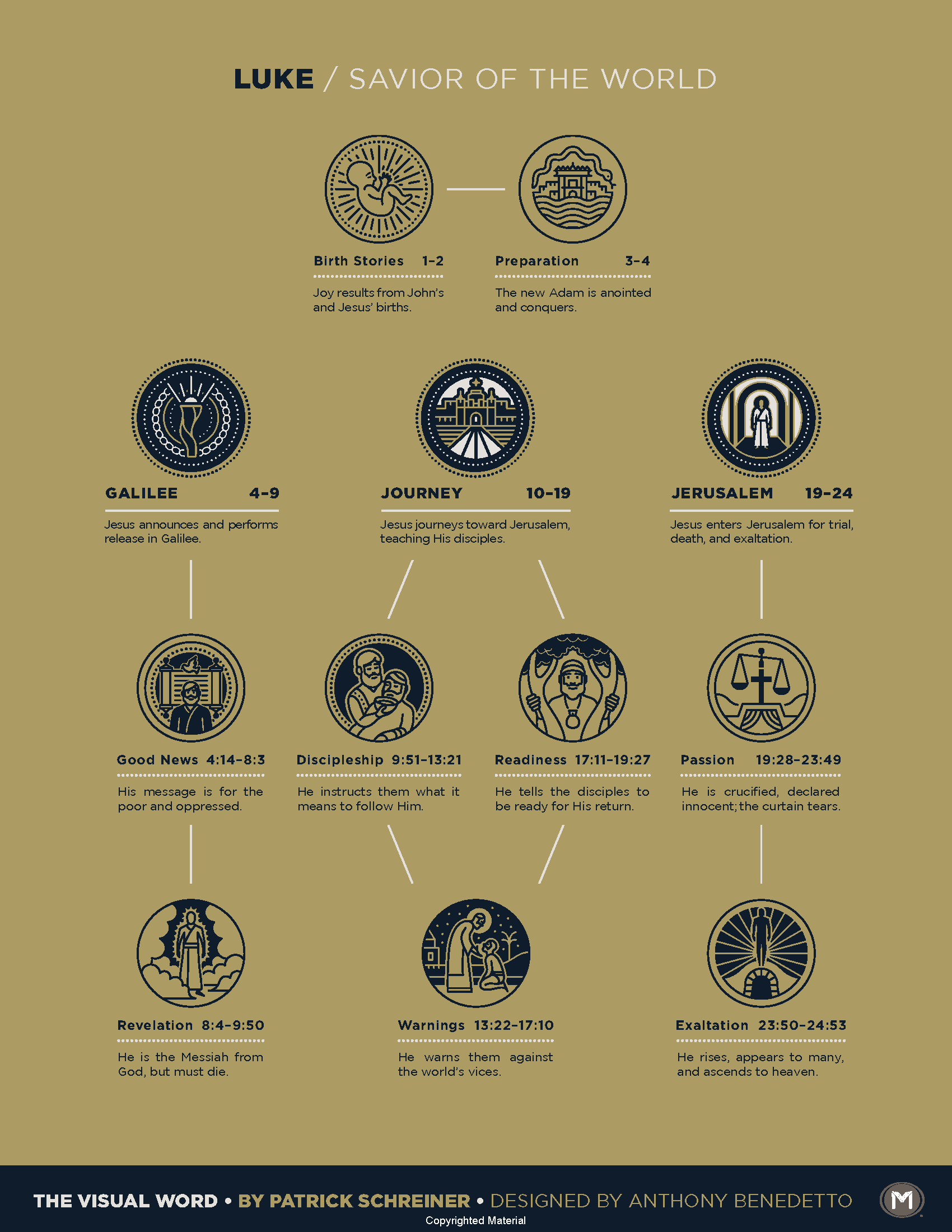
[1] R. C. Sproul, A Walk with God: An Exposition of Luke (Great Britain: Christian Focus Publications, 1999).